Confession: I stole a set of measuring cups as a kid.
I wanted to be just like Mommy, flipping pancakes and baking chocolate chip cookies, so when she left the old tan set sitting on the counter, I slipped in, stood on my tippy-toes, and snuck off before anyone saw me. And despite banging them around my Fisher Price Kitchen for all of preschool, it took me another 13 years to finally figure out how to use them properly.
But I completely forgot to share those secrets with you!
So today, we’re going back to the basics. Many of you may know these tips and tricks already, but skim through them anyway—every one of them will convert you from a beginner into a baking pro!
The Recipe
- Read through the recipe completely before beginning. I know, I know… You’re probably rolling your eyes at me. But raise your hand if you’ve ever dove straight into creaming butter or mixing muffin batter after only reading the ingredients list. (Both of my hands are high up in the air!) It only takes an extra minute or two, but reading through every step will save you time, flour, and lots of burned cookies.
- Watch out for commas! It’s a subtle point, but how the ingredients are written dictates how you prepare and measure them. For example, “1 cup sifted all-purpose flour” means sift the flour before measuring, whereas with “1 cup all-purpose flour, sifted,” you would measure first and sift after. Perform any tasks on the ingredients in the order that they’re written: anything that comes after the comma is done second.
- Understand the language. Sliced, diced, chopped, cut, broken, beaten… Each word means something slightly different, so if you aren’t familiar with any of the terms in a recipe, look them up!
The Measurements
A quick tip before we dive in… I highly recommend investing in a kitchen scale, especially for measuring dry ingredients! This is the one I own. It’s really affordable, and I’ve used it almost every day for 4+ years. It’s my #1 secret for making sure that my recipes turn out with the perfect taste and texture every time I make them!
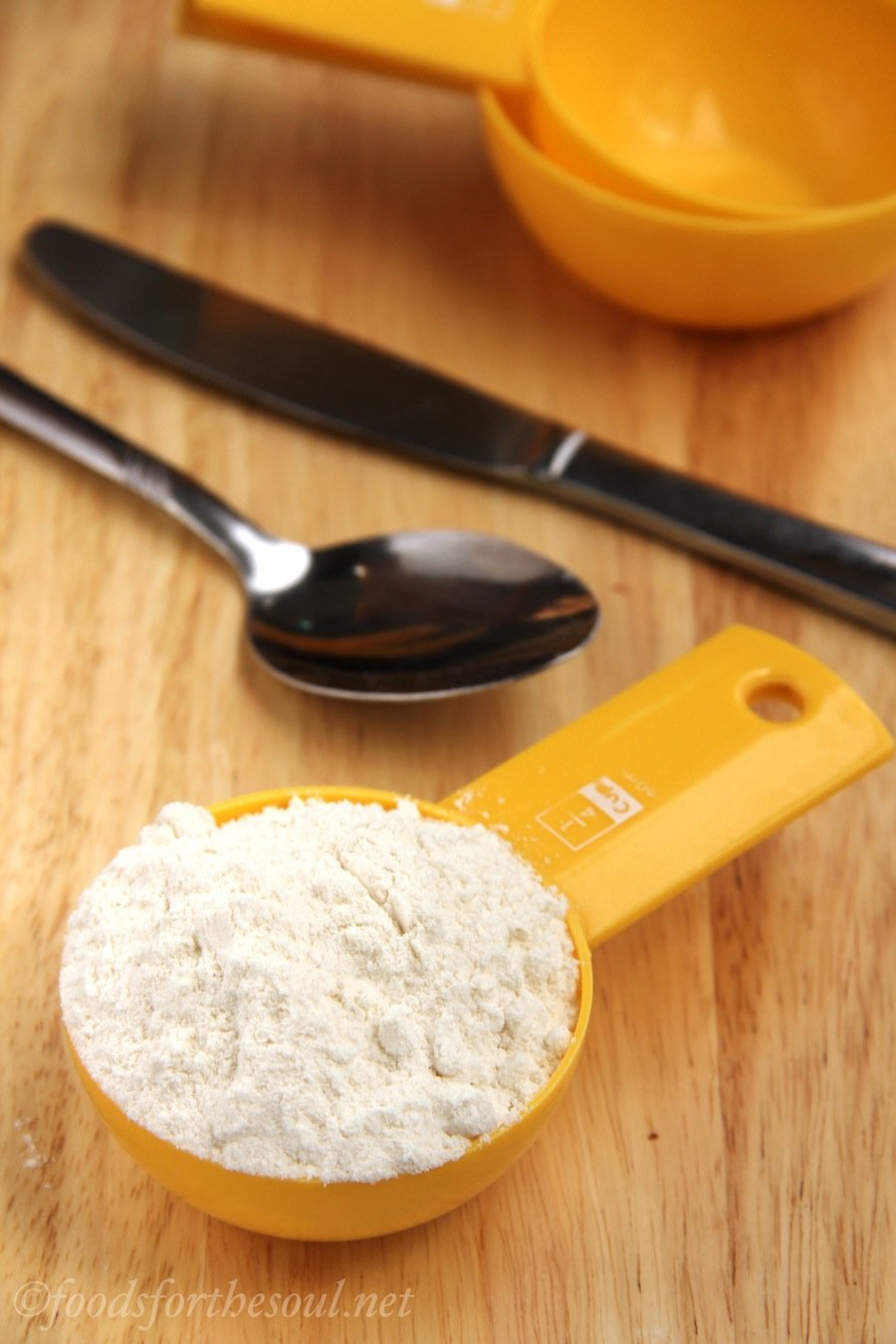
- Flours. All-purpose, whole wheat, gluten-free, peanut, almond, coconut, cocoa powder, and even oats are all the same. Use a fork to “scoop” up flour (or whatever you’re measuring!) from the container, and lightly shake the fork back and forth over the top of your measuring cup to transfer the flour into it (like you’d do with a hair drier!). Once there’s a small mound of flour extending above the rim of the measuring cup, then place the flat backside of a knife against the top of the measuring cup, and gently scrape it across the top to get rid of the excess flour. Never “pat” the flour down with the knife or fork, and never shake the measuring cup either. Also, do NOT scoop the flours, cocoa powder, or oats directly out of the container with the measuring cup or pack them in. This results in 1.5 times more than is required in a recipe, which dries out your baked goods and turns them crumbly. Not good! However, this fork method acts like a sifter (without dirtying another dish!) and guarantees you’ll add the correct amount of flour to your recipe!
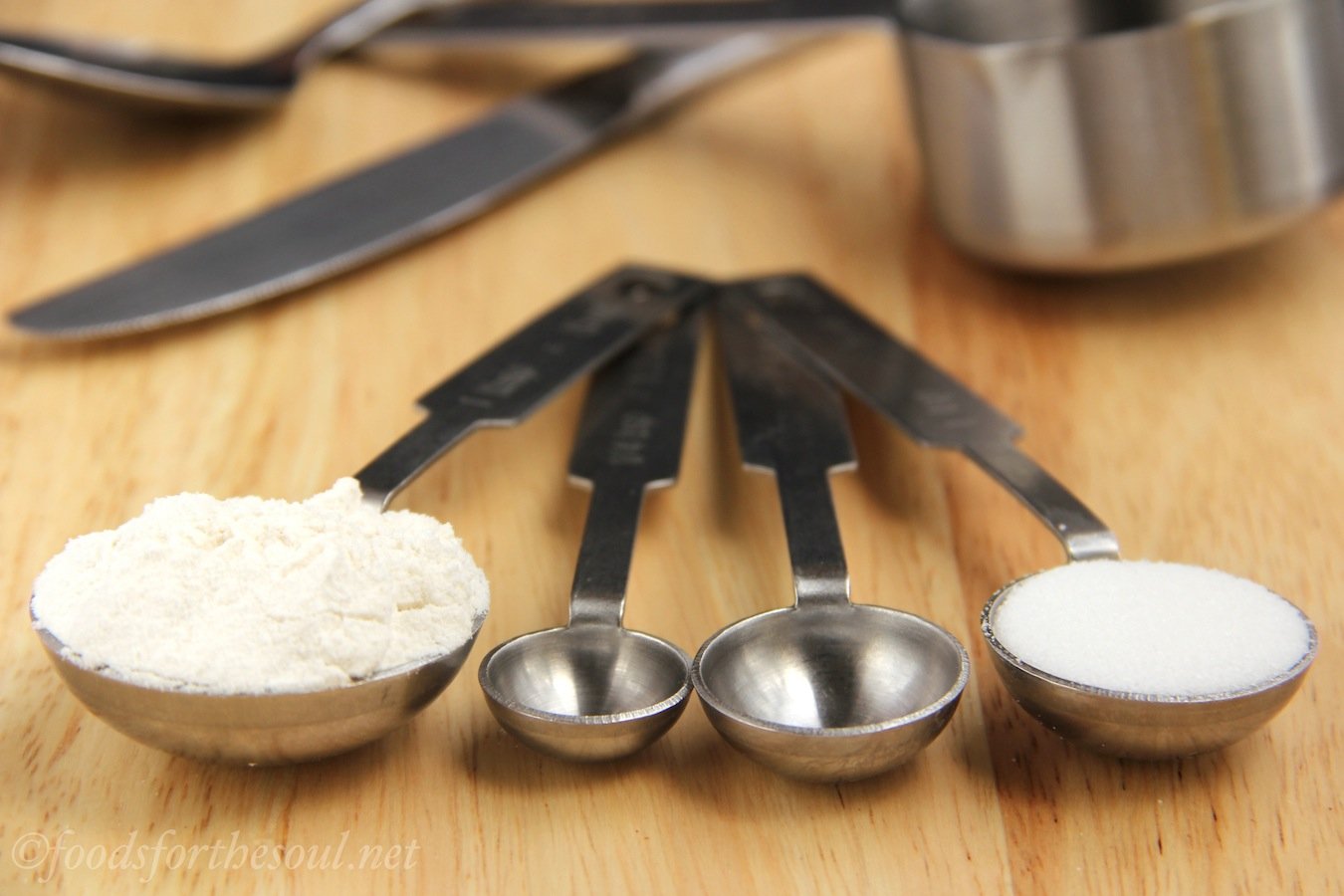
- Leaveners. With baking powder and baking soda, lightly fluff the leavener with a measuring spoon before scooping it out and leveling with a knife. Some containers have a flat edge built in—that works too!
- Sugars. For white sugar, use the same technique described for flours, except use a spoon instead of a fork. With brown sugar, lightly pack it into the measuring cup using a fork or spoon until the cup is completely filled and level (unless the recipe states otherwise). When you invert the measuring cup, the brown sugar should be packed tightly enough to hold its shape.
- Salt and spices. Treat them like the leaveners: fluff, scoop, level.
- Butter and margarine. Most stick-style butters and margarines are wrapped in a label with tablespoons marked on the side. Count out how much you need, and cut through the stick with a sharp knife. You should avoid using a butter knife because the blade is duller and you won’t carve off as accurate of an amount. With tub-style butter, margarine, and shortening, press the necessary quantity into a measuring spoon or cup, and level with a knife.
- Liquids. Milk, oil, juice, honey, syrup, and extracts are a little tricky. If using regular measuring cups, place the measuring cup on the counter, pour in the liquid, and get down at eye level. The liquid at the edges tends to stick to the sides of the cup, while the liquid in the center curves upward ever so slightly. You want to make sure the center of the liquid is even with the rim of the cup for the most accurate measurement. You can also use a clear liquid measuring cup instead. Here, the liquid in the center sinks down a touch. (In science-speak, it’s called a meniscus!) The bottom of that concave meniscus should brush the top of the marking lines on the liquid measuring cup’s side, almost so it looks as if you’ve added slightly more of the liquid. For teaspoons and tablespoons, fill them to the brim but not overflowing or bulging out the top. And be careful when pouring the liquids into the mixing bowl! (Also, never use a kitchen scale to measure liquids. The “ounces” option on kitchen scales is for dry ounces, not liquid ounces!)

I may add to this post as new things come up in the future. But for now, it’s time to bake something sweet! Which of these recipes are you going to try next? I can’t wait to hear!! ♡


Are the cups you use american? Bc a us cup and metric cup are different evem if you use level and spoon methos. For e.g is a cup of flour equivalent to 140g? Cup of white sugar 200g? Cup of apple suace or oil 250ml?
Yes, I’m in the US, so my measuring cups are American! Measuring cups go by volume, whereas weights go by density. So 1 cup of flour and 1 cup of sugar take up the same amount of space (volume), but because flour is lighter in weight than sugar, 1 cup of flour is 120g while 1 cup of sugar is 192g. In most of my recipes, I include both American cups and metric measurements, so go by the metric measurements if you’re unsure! 🙂 I can’t wait to hear what recipe of mine you try next, Li!
So taking a measuring cup and scooping the flour & then leveling it off (with a knife or other baking utensil) so it’s even at the top results in more flour used than is needed? I want to make sure I’m understanding what you’re saying correctly because that’s how I usually do it and I am getting ready to try some of your recipes.
I truly appreciate your interest in my recipes Laura! When measured like that, where you scoop the flour from the container with your measuring cup, yes — you can end up with 1.5 times as much flour as when you lightly spoon and level! If you don’t own a kitchen scale, here’s what I recommend doing for measuring flour (and cocoa powder, oats, etc!): use a fork to “scoop” up flour from the container, and lightly shake the fork back and forth over the top of your measuring cup to transfer the flour into it. Once there’s a small mound of flour extending past the rim of the measuring cup, then place the flat back of a knife against the top of the measuring cup, and gently scrape it across the top to get rid of the excess flour. Never “pat” the flour down with the knife or fork. This fork method acts like a sifter (without dirtying another dish!) and guarantees you’ll add less flour to the batter, so you’ll end up with moist and tender treats. Does that make sense? 🙂 I’m so excited to hear which of my recipes you try!!
Thanks for explanation Amy! I’m looking forward to trying your recipes, they all look so good. : )
My pleasure Laura! You’re so sweet to say that about my recipes — it means a lot! 🙂 I can’t wait to hear what you try first!
then you can always measure and sift and then measure again … just my personal thoughts!
Thanks for sharing! 🙂
Hello Amy
Thank you for this very useful blog! Even us older cooks need a refresher.. love the idea of fluffing powders and using a fork instead of a spoon. I’ve noticed that some of the butter knives i have are not straight across on the oppsite side of the blade.
I just live your blog and recipes and especially your private tips and stories og your lovely mom.
I had forgotten about the old method of measuring shortening or butter using water!! I remember my own mother doing that in the early 60s when I was little and would pull up a kitchen chair to watch what was going on lol
Thanks all the way from Western Canada !! Dena
I’m so glad you’re enjoying my blog and my stories Dena! That means a lot to me! 🙂 I’m especially happy that you found these tips useful too, and I can’t wait to hear what recipe of mine you try next!
Thanks Amy.
Great Tips. It’s enough trouble trying to substitute healthy products for unhealthy products without getting the measurements wrong as well. This had improved my confidence no end. Thanks also for the recipes.
Joe.
My pleasure, Joe! I can’t wait to hear which recipes of mine you try next!
I say a Big Thank You for the tips given and I hope to try some of your recipes some time soon
You’re so kind Helen — that means a lot to me! 🙂 I’m so excited to hear what recipe of mine you try next!
Learned to bake on submarines where just about everything in the dessert, rolls, bread etc field is made from scratch. There is no place to hide if you screw up the recipe. I had a terrible time with baking powder biscuits and still don’t make the greatest pie crust. Only one thing would I add to your terrific instructions; never measure anything directly above the product, always off to the side. If you make a mistake its very difficult to remove the mistake from the product and you may have to start over. Going to make the Healthy Apple Pie Oatmeal; cookies a little later today. Semper Fi, the Chief.
Such a great tip! Thanks for sharing! 🙂 I can’t wait to hear what you think of the apple pie oatmeal cookies!
Hi, I was just looking for recipes using carrots and happily found your oatmeal carrot cake cookies ? which I will be making as soon as I get some maple syrup and cream cheese ?
I go through phases of not baking and then baking crazy hehe I’ve always used measuring spoons for liquids, brown sugars and butter/marg etc. My results are very varied ? and reading through your baking basics I I’m pretty sure my measurements must be off so thank you very much for this simple logical guide, it really makes sense ? thank you
It’s my pleasure Etak! I’m so glad you found this useful. And I’m even happier that you enjoyed the oatmeal cookies! 🙂 I can’t wait to hear what recipe of mine you try next!
Hi Amy,
How would you measure/level 3/4 or 1/2 of a cup of dry ingredients?
Greetings from Greece!
Hi Barbara! 🙂 I’d follow the method I outlined above for flour using a ½-cup measuring cup for ½ cup and a ¼-cup measuring cup (three times!) for ¾ cup of dry ingredients. I can’t wait to hear what recipe of mine you try next!
Thank you, Amy! I was thinking of the Ultimate Healthy Dark Chocolate Cupcakes ?
My pleasure, Barbara! One of my favorites — I definitely approve! 😉 I can’t wait to hear how your cupcakes turn out! 🙂
??
I reviewed these just to be sure your methods are the same as mine and they are! Brings me back to my 4-H, mom in the kitchen as a helper, and school home economics days! These are skills I learned early and I’m glad to see they are still used today. (And I’m not telling my age-lol!)
That’s so wonderful to hear that these are the same methods that you learned! I absolutely loved my home-ec class in middle school. We made the most amazing (and seriously unhealthy) decadent chocolate cake and sewed our own pillows. So fun! Thanks for the trip down memory lane too! 😉 I can’t wait to hear what recipes of mine you decide to try next, Sandal!
Only in the US do we make it so hard! Bakers world-wide use weights for dry stuff, which eliminates the need for all this 😉 Thanks for the explanation, though, good tips for baking accurately.
So glad you found this useful! 🙂 I can’t wait to hear what recipe of mine you decide to try next!