

Despite the porcelain Peter Rabbit cookie jar prominently displayed on our kitchen countertop, Mom only preheated the oven once every month or two to fill it with homemade treats. Instead, she dropped Little Debbie chocolate snack cakes or oatmeal cream pies into our insulated lunch boxes for our desserts at school. But on the rare occasions she plugging in the handheld electric mixer to cream butter and sugar, she always turned to the Nestle chocolate chip bag as her recipe.
My younger brother and I anxiously hovered in the kitchen, pleading to help place spoonfuls of dough onto the stained baking sheets. We needed to supervise the bowl as she scraped and shaped. Make sure to leave some for us, Mommy!

Sitting cross-legged on the tile floor, I drew a line down the center of the wide metallic mixing bowl. I smooshed my finger around my half in straight lines to get my fair share of the “leftover” cookie dough, while my brother haphazardly scraped his side in squiggles and circles. Mom generally pretended to forget about a couple of chocolate chips in the bowl too, and we divided those evenly, sneaking an extra one from the bag if necessary to even our shares.
When the timer dinged and Mom granted us permission, we grabbed a warm cookie from the cooling rack and sank our teeth into the soft dough. Melted chocolate oozed across our fingertips, which we happily sucked off before reaching for more.

Eight years later, as a high school freshman in Health Class, I stared at the Food Pyramid as I soaked up the teacher’s lecture. Less sugar… Lower fat… Sweets in moderation… That afternoon, I eliminated the Tollhouse recipe from my repertoire and vowed to bake only healthier low-fat cookies.
In the ensuing decade, I realized one fatal flaw: most low-fat cookies didn’t feel right. With proper ingredient ratios, they could taste as rich and sinful as their indulgent counterparts, but their texture fell closer to that of a cake-like muffin than a soft and chewy cookie.
So 2 months ago, I challenged myself to create the ultimate healthy soft and chewy chocolate chip cookie. After 7 different batches, my 10 taste testers agreed: this is it!
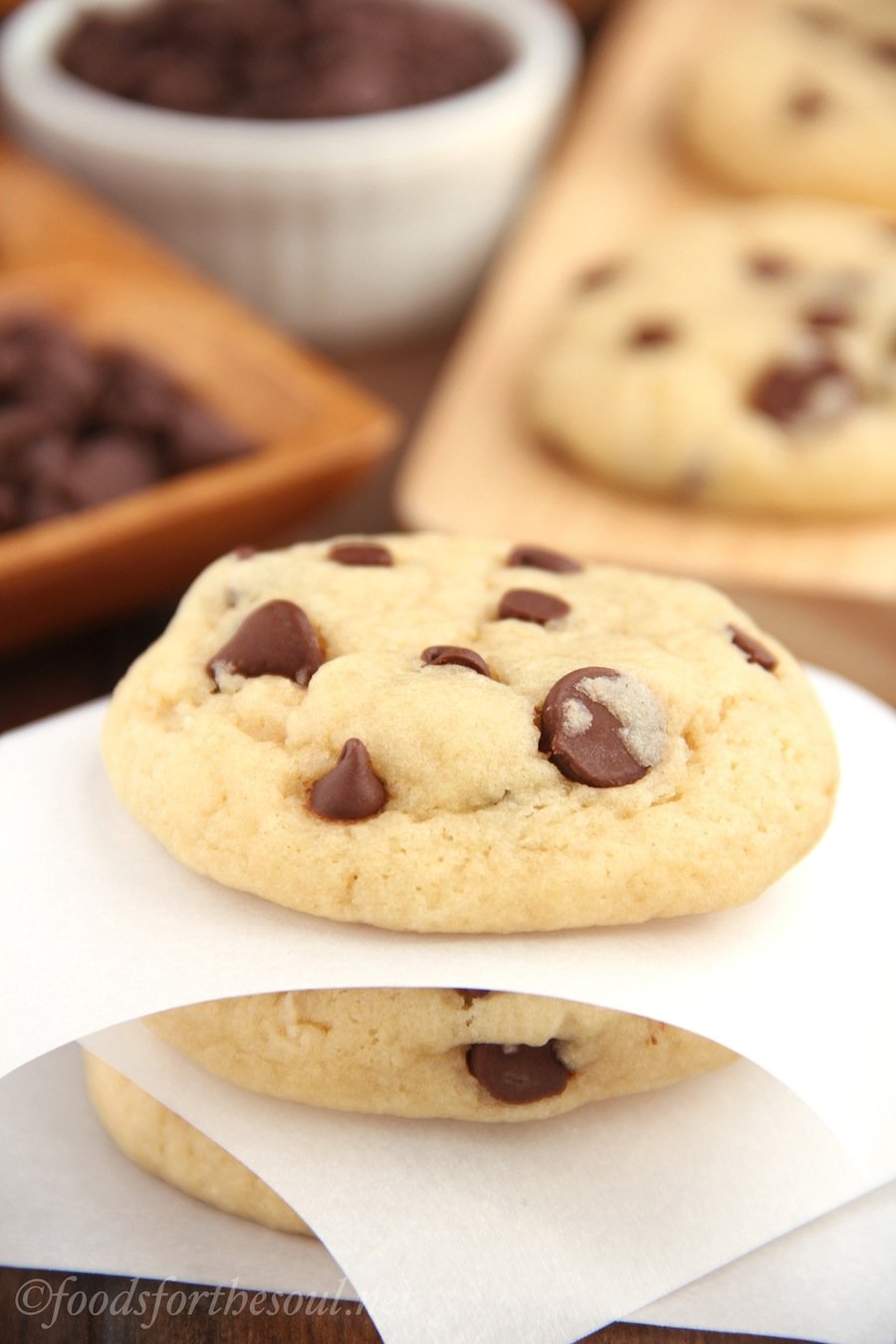
I started with the butter because it was the biggest obstacle in developing a healthy chocolate chip cookie recipe. After countless tweaks, I noticed a trend. To achieve a chewy texture, the cookies needed a minimum of 18% of their calories to come from butter (or margarine). Anything less resulted in a bready muffin texture. Six tablespoons for 2 dozen cookies provided the perfect amount of chew.
To further increase their chewiness, I used melted butter. This means you can stir the cookie dough together with a spoon. No electric mixer required (and one less thing to wash)!
Although other bakers and bloggers proclaim that extra egg yolks also increase cookies’ chewiness, I completely eliminated them and just added egg whites to lower the fat and cholesterol. Don’t worry, the cookies will still be chewy! We started with the perfect amount of melted butter, remember?
Make sure your egg whites are at room temperature! If still cold from the fridge, they’ll chill the melted butter and partially turn it back into a lumpy solid. Not good! To warm up your egg whites the easy way, place the entire egg in a bowl of warm water for 5-10 minutes while measuring the dry ingredients.

I also mixed in a touch of skim milk to increase the moisture and better balance the liquid-to-dry-ingredient ratio. Feel free to substitute whatever you usually store in your fridge: 1%, 2% whole, rice, almond, soy… We want to keep these cookies simple so you don’t need to buy any strange new ingredients!
We’re going to add more vanilla than most recipes require. Extra vanilla mimics a buttery flavor, without the excess fat and calories. You’ll need 4 teaspoons for these healthy cookies.
While the Tollhouse cookies call for half white and half brown sugar, I opted for all brown. Brown sugar increases the moisture and chewiness of these skinny chocolate chip cookies and also adds a subtle hint of caramel. Yum! Either light or dark brown sugar will work.

As you probably predicted, I reached for regular all-purpose flour for this recipe. It is imperative that you measure the flour correctly (see here for details). Adding too much results in dry, crumbly, muffin cookies instead of the extra soft, extra chewy ones we want. Sprinkle in a little salt for flavor, and you’re all set!
As for leaveners, I selected baking powder. Some recipes list baking soda as well, but I omitted it for 2 reasons: (a) to simplify the ingredients list and (b) the cookies lack a good acid source to activate it. (Baking powder = baking soda + added acid. Yes, I’m still a chemistry geek at heart!)
I also stirred in cornstarch. Cornstarch helps the cookies stay thick and moist. It sounds strange, but it’s been my secret weapon for many of my cookie recipes! (See here, here, here, here, and here.)
Finally the most important part: the chocolate chips! My tongue dances and my eye roll back in my head a bit every time my teeth hit a large gooey chunk of melted chocolate, whereas disappointment sinks in on the bites without. To counteract the latter, I measured out regular semisweet chocolate chips for the big burst as well as minis to ensure every bite contained some chocolate. Most taste testers agreed that they preferred a 2:1 regular-to-mini chip ratio.
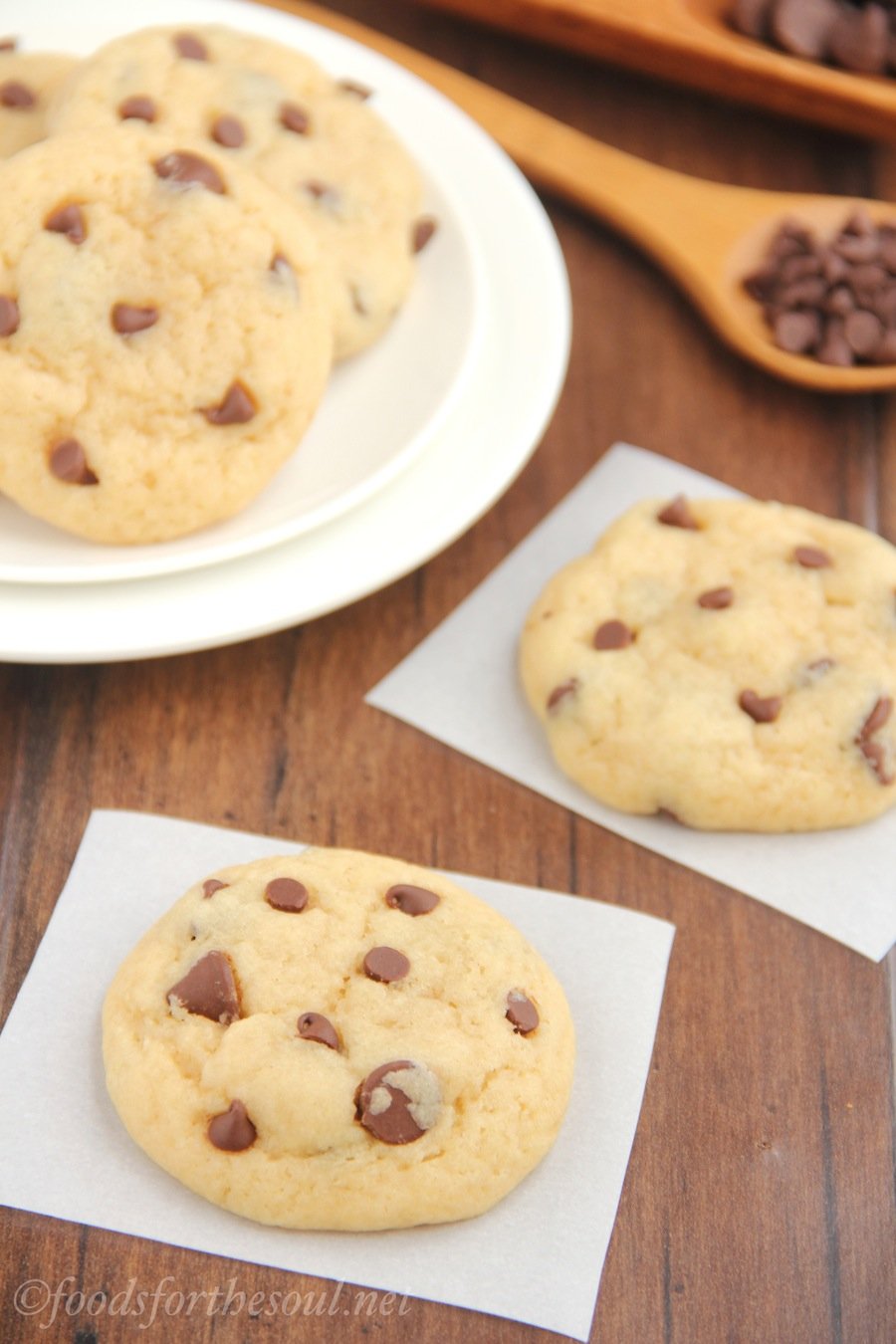
To mix up the dough, simply whisk together the dry ingredients, stir the wet ones in a separate bowl, combine the two, and fold in the chocolate chips. So easy! I usually reserve about half of the mini chocolate chips to press into the tops of the dough just before baking as a pretty finishing touch. They look so tempting—they’re practically begging you to eat one!
Before popping in the oven to bake, you must chill the dough. Chilling is mandatory for thick cookies. Try to refrigerate the dough for at least 30 minutes. I prefer chilling mine for 4 hours, but I know that’s a struggle with out-of-control cookie cravings!
These lightened chocolate chip cookies require barely any time to bake—just 10-12 minutes. They will look and feel slightly underdone, but they’ll continue to cook while sitting on the warm baking sheet.

Whew, that was a lot of information! Here’s a quick recap of the key components of the Ultimate Soft and Chewy Healthy Chocolate Chip Cookies:
»» less butter, and melted for chewiness
»» more vanilla for buttery flavor
»» brown sugar for moisture and chew
»» cornstarch for softness and thickness
»» regular and mini chips for more chocolate throughout
»» chilling for thickness
»» baking 10-12 minutes for softness
Ready for a tall glass of milk and a big stack of cookies?
And when you make your own, remember to snap a picture and share it on Instagram using #amyshealthybaking and tagging @amyshealthybaking IN the photo itself! (That guarantees I’ll see your picture! ?) I’d love to see your cookies and feature them in my Sunday Spotlight series!
Psst… My newly released Healthier Chocolate Treats cookbook is full of sweet and healthy recipes like these chocolate chip cookies! Learn more and buy your copy here!
| The Ultimate Healthy Soft & Chewy Chocolate Chip Cookies | | Print |
- 2 cups (240g) white whole wheat flour or gluten-free* flour (measured like this)
- 1 ½ tsp baking powder
- 1 ½ tsp cornstarch
- ¼ tsp salt
- 6 tbsp (84g) unsalted butter or coconut oil, melted and cooled slighlty
- 2 egg whites, at room temperature
- 1 tbsp (15mL) skim milk
- 4 tsp vanilla extract
- 1 cup (192g) coconut sugar or light brown sugar
- ¼ cup (56g) regular chocolate chips
- 2 tbsp (28g) miniature chocolate chips, divided
- In a medium bowl, whisk together the flour, baking powder, cornstarch, and salt. In a separate bowl, whisk together the melted butter and egg whites until small bubbles form (about 15-30 seconds). Whisk in the milk and vanilla extract. Stir in the brown sugar, smearing out any clumps along the side of the bowl. Add in the flour mixture, stirring just until incorporated. Fold in the regular chocolate chips and 1 tablespoon of mini chocolate chips. Cover the top with plastic wrap, and chill for at least 30 minutes. (See Notes.)
- Preheat the oven to 350°F, and line two baking sheets with silicone baking mats or parchment paper.
- Drop the cookie dough into 24 balls onto the prepared baking sheets. Flatten slightly to about ¾” thick. Press the remaining mini chocolate chips into the top of each. Bake at 350°F for 10-12 minutes. Remove from the oven and allow the cookies to sit on the warm baking sheet for 10 minutes before transferring to a wire rack.
Do NOT overbake these cookies! After 10-12 minutes in the oven, they’ll still look and feel slightly underdone, but they’ll continue to bake and set on the warm baking sheet for the 10 minutes after.
For a vegan version, use coconut oil or margarine in place of the butter, 1 tablespoon Ener-G + ¼ cup warm water in place of the egg whites, and non-dairy milk in place of the skim milk.
For a gluten-free version, see this recipe of mine.
Whole wheat pastry flour, regular whole wheat flour, or all-purpose flour may be substituted in place of the white whole wheat flour.
It's extremely important to measure the flour correctly, using the method outlined in the links above or a kitchen scale. (I highly recommend a kitchen scale! This is the one I own, and it has been the best $20 I’ve ever spent. I swear by it!) Too much flour will make your cookie dough dry and your cookies turn out cakey or crumbly.
For a more decadent treat, I highly recommend using these dark chocolate chips in place of the regular chocolate chips!
{gluten-free, clean eating, vegan option, low fat}
View Nutrition Information + Weight Watchers Points


Hi, Amy! These cookies look gorgeous! 🙂 I want to know if the texture will be as good if I use a whole egg instead of just egg whites. Or maybe use two eggs and eliminate the butter/coconut oil? TIA!
I really appreciate your interest in my recipe June! These cookies do require the butter/coconut oil, but you’re welcome to use two full eggs if you prefer. Just reduce the milk to 1 teaspoon to compensate for the added volume! 🙂 I’m excited to hear what you think of them!
I doubled the recipe with three whole eggs and put less salt. They tasted really good, but the texture was very cakey.
I really appreciate your interest in my recipe Glo! I’d love to help you solve that cakey texture issue. 🙂 Did you make any modifications to the recipe, including those listed in the Notes section? How long did you chill the cookie dough? How much you flatten it before baking, and how long did you bake your cookies? Finally, how did you measure the flour, with a kitchen scale or measuring cups? Once I know all of your answers to those questions (I know it’s a lot of questions!), I’ll have a much better idea of what happened and how to prevent it from happening again!
Can I substitute almond milk for the skim milk? That’s not something I usually keep in the fridge!
Yes, that’s fine! I’d love to hear what you think if you try making these cookies Matty! 🙂
I should have read the article first- you had already addressed the milk question!
I made these cookies with Bob’s Red Mill Paleo flour, and I had brown coconut sugar in the pantry that I used, and these cookies came out amazing! They’re a teeny it grainy because of my flour choice but even my husband declared they were delicious!
I’m so glad you loved these cookies Matty! That’s such a huge compliment if your husband called them delicious as well. I’m really honored that you’d take the time to let me know — thank you SO much!! 🙂
Hi Amy, I’m so excited to try making the cookies! LOVE the fact that they use less butter, as most chocolate chip cookie recipes use tons of butter and where I am butter is not so common…. Thanks for posting this recipe ❤️
I’m so honored that you want to try my recipe Flo! I can’t wait to hear what you think of these cookies!! 🙂
Hey Amy, your recipe looks really interesting! I would like to know is there any other oil that can be used in place of butter/coconut oil? And if I use less sugar, will it change the texture of the cookies? Thanks!
I’m honored that you’d like to try making my recipe, Damini! Yes, if you use less sugar, the texture of the cookies will be quite different. They’ll turn out with a bready or cakey texture (or if you use a LOT less, they’ll be too dry and crumbly to hold together!). Is there a particular oil that you have in mind? I know it’s hard to locate certain ingredients at grocery stores right now! 😉
hello amy! i would love to try this recipe but because i am on a low calorie diet i was wondering if i can use stevia sweetener packets instead of the sugar?
thank you
I’m honored that you’d like to try my recipe, Basma! If you substitute stevia sweetener packets, you’ll need to add a lot of milk to fully incorporate all of the dry ingredients and get the correct dough consistency. This is because stevia packets don’t absorb or dissolve in liquids the same way regular sugar or coconut sugar do. As a result, your cookies will turn out more cakey or bready than soft and chewy. I just wanted to make sure you knew that the texture would be different before you began! 🙂 If you’re fine with that texture difference, then what are the exact stevia packets (brand + product name) that you’d like to substitute?
the brand is called steviana sweetener.
is there any way to get a chewy texure or is it impossible?😅
and would it be okay if i used fat free milk?
Thank you for sharing, Basma! Fat-free milk is the same thing as skim milk (also called nonfat milk — I don’t know why we have three different names for the same item here in the US!), so yes!
I just researched the Steviana stevia sweetener packets. It looks like one packet is the equivalent of 2 teaspoons of granulated sugar. Is that correct? If so, then you’ll need 24 packets to replace the 1 cup of coconut or light brown sugar. You’ll also need to add an additional 6-8 tablespoons of milk to compensate for the missing volume.
It’s not completely impossible! If you use closer to 8 tablespoons of milk, rather than closer to 6 tablespoons, you should end up with a wetter and stickier cookie dough. It’ll be a bit harder to work with (do NOT use your hands!! just use a spoon and spatula to transfer it to your baking sheet), but as long as you don’t overbake it (the centers should still feel soft and a bit underdone when you remove the cookies from the oven — NOT completely firm!), then you should get a somewhat chewy texture. Your cookies won’t be quite as chewy as the original version of this recipe, but they won’t be totally cakey and bready either!
Does all of that make sense? 🙂
yes thank you so much!
You’re welcome, Basma! I’m really looking forward to hearing what you think of these cookies!