
Throughout our childhood, my brother and I celebrated nearly every one of our birthdays with a pool party since we were both born during the summer. Back then, we belonged to a simple pool club in a quiet neighborhood, which was the perfect place for a children’s birthday gathering.
We kept those parties small, only inviting a handful of our closest friends, but we still loved every minute of the celebrations. For hours, we practiced cannonball jumps in the deep end and underwater somersaults in the shallow side, and we usually pulled out a set of neon-colored plastic diving rings to play with, too.
Eventually, Mom called us all out of the water, and we eagerly obliged… Because that meant it was time for cake!

Two weeks earlier, Mom had taken us to the grocery store, and she let us slowly pore through the bakery’s big binder of birthday cake options. A beautiful color photograph of each confection filled every page, but after an eternity of flipping through the binder, I often picked out a chocolate cake with a Disney theme, while my brother generally chose a vanilla cake with race cars instead.
At our parties, Mom carefully opened the big bakery box to reveal the gorgeous cake we had ordered, which came with “Happy birthday!” scripted across in icing letters. After blowing out the candles, I always wanted the piece with my name on it… Or at least the slice with the most frosting!

Although I still love chocolate cake, my brother eventually gravitated towards lemon instead of vanilla, so I had him in mind when I baked this healthy lemon bundt cake! It’s really moist and full of bright citrus flavor, just the way my brother likes his lemon cakes, but unlike the multi-layered bakery birthday cakes of our childhood… This one is really easy to make. No need for frosting, decorating, or any assembly!
I can’t wait to bake it again for his birthday in August! ♡

QUICK OVERVIEW – HEALTHY LEMON BUNDT CAKE
Difficulty: Mainly easy, including for many beginner bakers.
Taste: Sweet and bright with plenty of fresh citrus flavor.
Texture: Very moist, tender, and soft.

KEY INGREDIENTS TO MAKE A HEALTHY LEMON BUNDT CAKE
Let’s go over the key ingredients that you need to make this healthy lemon bundt cake — entirely from scratch! You’ll also need a few baking staples (like vanilla and salt!), but I have a sneaky suspicion that you’re familiar with those and already have them on hand… So we’ll focus on the more interesting ingredients instead!
Flour. You’ll start with white whole wheat flour. Yes, such a thing actually exists… And it’s not just a combination of white (aka all-purpose) flour and whole wheat flour!
Instead, white whole wheat flour is made by finely grinding a special type of soft white wheat (hence the name!), whereas regular whole wheat flour comes from a heartier variety of red wheat. This gives white whole wheat flour the same health benefits as regular whole wheat flour (like extra fiber!), but it also has a lighter taste and texture. That lets the moist texture and lemon flavor truly shine in this healthy bundt cake!
Hint: The difference between white whole wheat flour and regular whole wheat flour is like the difference between red and green grapes. They both have similar nutrition benefits — just a different color and slightly different flavor!
Tip: If you’d like to make your healthy lemon bundt cake gluten-free, then see the Notes section of the recipe. I’ve shared how to do so there!
Leavening agents. You also need both baking powder and baking soda for this healthy lemon bundt cake. Although some recipes just use baking powder, the baking soda helps this cake rise just as much — if not more! That’s because the baking soda is a strong base, so it reacts with the lemon juice (an acid!) to create air bubbles (carbon dioxide, to be exact!) that make your lemon cake rise… And that reaction also helps yield a more tender texture.
As an ex-chemist, I love nerdy baking science like this! 😉
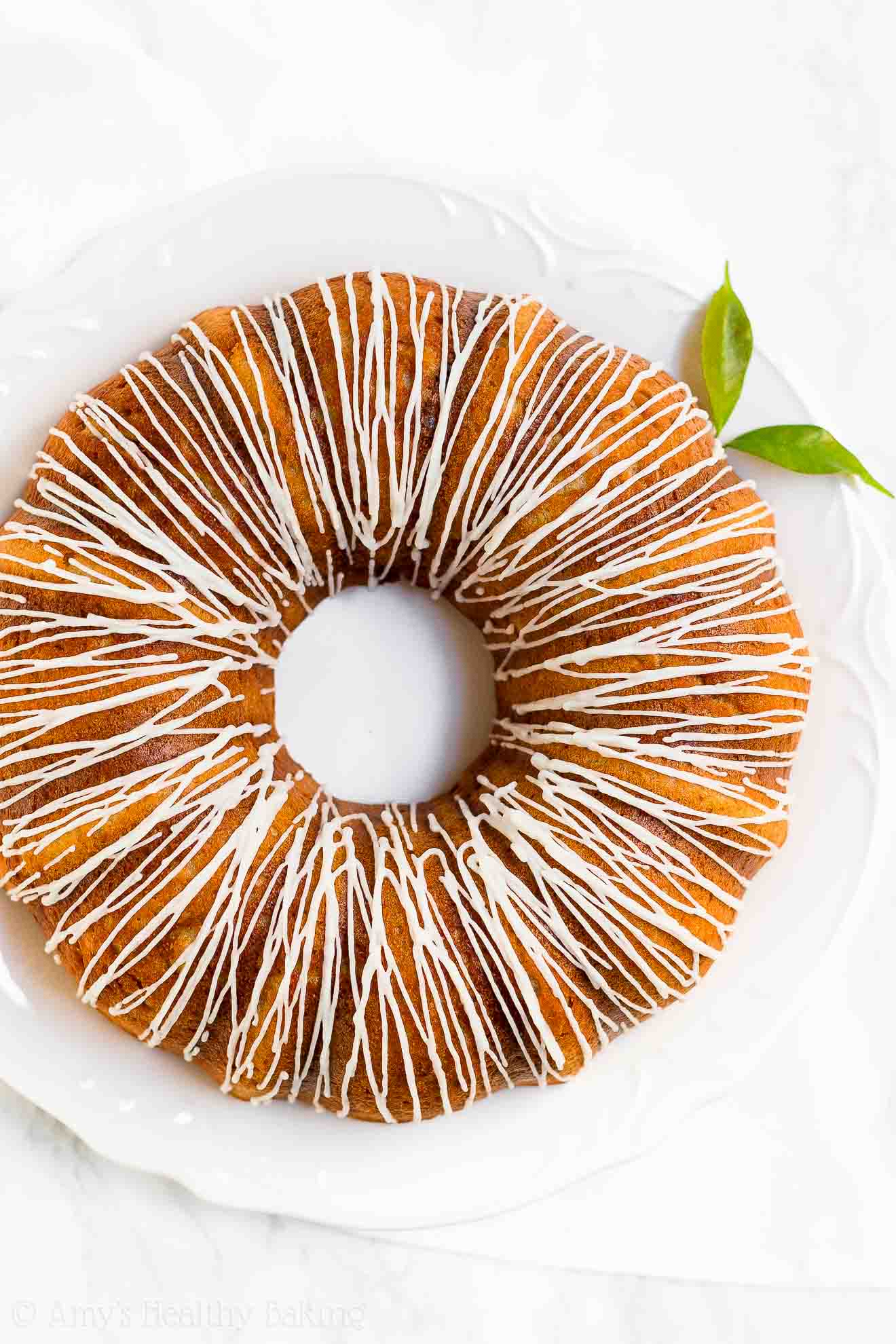
Unsalted butter or coconut oil. Unlike traditional recipes that call for ½ to 1 full cup of butter or oil, you only need 1 tablespoon for this recipe. That really helps keep your healthy lemon bundt cake low calorie and low fat! Yet it’s just as moist and tender because of another ingredient…
Greek yogurt. This is one of my favorite healthy baking ingredients! In this recipe, Greek yogurt adds the same moisture to the batter as extra butter or oil but for a fraction of the calories. It also gives your lemon cake a big protein boost!
Egg whites. The whites contain the majority of eggs’ protein, and that comes in handy with cake recipes. The protein provides structure and helps your cake stay nice and tall while cooling, instead of collapsing or sinking.
Sweetener. Instead of refined granulated sugar, you’ll sweeten your healthy lemon cake with another one of my favorite ingredients: liquid stevia. Stevia is a plant-based, sugar-free, no-calorie sweetener that contains nothing refined or artificial (aka it’s clean-eating friendly!). It’s also highly concentrated. You just need 5 ½ teaspoons to sweeten the entire cake… Instead of 2 ¼ cups of granulated sugar. (That also helps keep this lemon cake low calorie!)
This is the liquid stevia that I use because I love its flavor and don’t notice any strange aftertaste like with some other stevia products. Although you can find it at many health-oriented grocery stores, I buy mine online here because that’s the best price I’ve found. (And you’ll use it in all of these recipes of mine, too!)
Tip: Many stevia brands and products have different sweetness levels, so they’re not necessarily 1-for-1 substitutes for each other. For the best flavor and texture, I highly recommend using the same one that I do!

Milk. Almost any kind will work. I typically reach for nonfat milk or unsweetened vanilla almond milk, and both produce beautifully moist and flavorful cakes. Feel free to try whatever currently sits in your fridge!
Lemon zest. Freshly grated zest is the first lemon component. (More on the second momentarily!) Lemon zest has a much stronger flavor than lemon juice, so it provides the majority of the citrus taste. I’ve tested this healthy lemon bundt cake multiple times, and you need 4 full tablespoons of zest to get the best and brightest flavor. Don’t skimp!
Tip: Use pure yellow lemons without any green spots. They yield the best lemon taste!

Lemon juice. Now it’s time for the second component of lemon juice — and another nerdy baking science lesson! Ready?
I specifically designed this recipe for Meyer lemons.
Meyer lemons are a special variety of lemons. They’re a hybrid of citron, mandarin, and pomelo. This blend gives them a fuller and sweeter flavor, and it also raises their pH level compared to regular lemons — meaning they’re less acidic. (Remember from basic chemistry? Higher pH = more basic and less acidic!)
That acidity, or pH level, plays a huge role in the texture of your cake.
If you use Meyer lemon juice, your cake turns out perfectly moist and tender inside. It rises nicely in the oven, maintains its height and structure while cooling, and looks like a normal lemon cake when you slice into it.
If you use regular lemon juice, that adds WAY too much acid. It substantially lowers the pH level of the batter and results in a cake that barely rises, looks raw inside (even though it’s fully baked all the way through — I promise!), and turns out with an incredibly dense and almost brick-like structure.
So if you can find Meyer lemons, please use them! However, if you can only find regular lemons, that’s okay too. I know many grocery stores don’t stock Meyer lemons, so they’re not always easy to locate.
If you can only find regular lemons, you’ll use less lemon juice — just enough to add the same amount of acid and create the correct pH level in the cake batter! — and substitute milk for the rest. This yields a cake with the exact same moist and tender texture, and because the zest provides the majority of the citrus flavor, your bundt cake will still taste bright, sunshiny, and perfectly lemony… Just like if you had used Meyer lemons!
Whew! You made it through! That wasn’t too hard, was it? The rest of this is as easy as pie — or, well, cake!
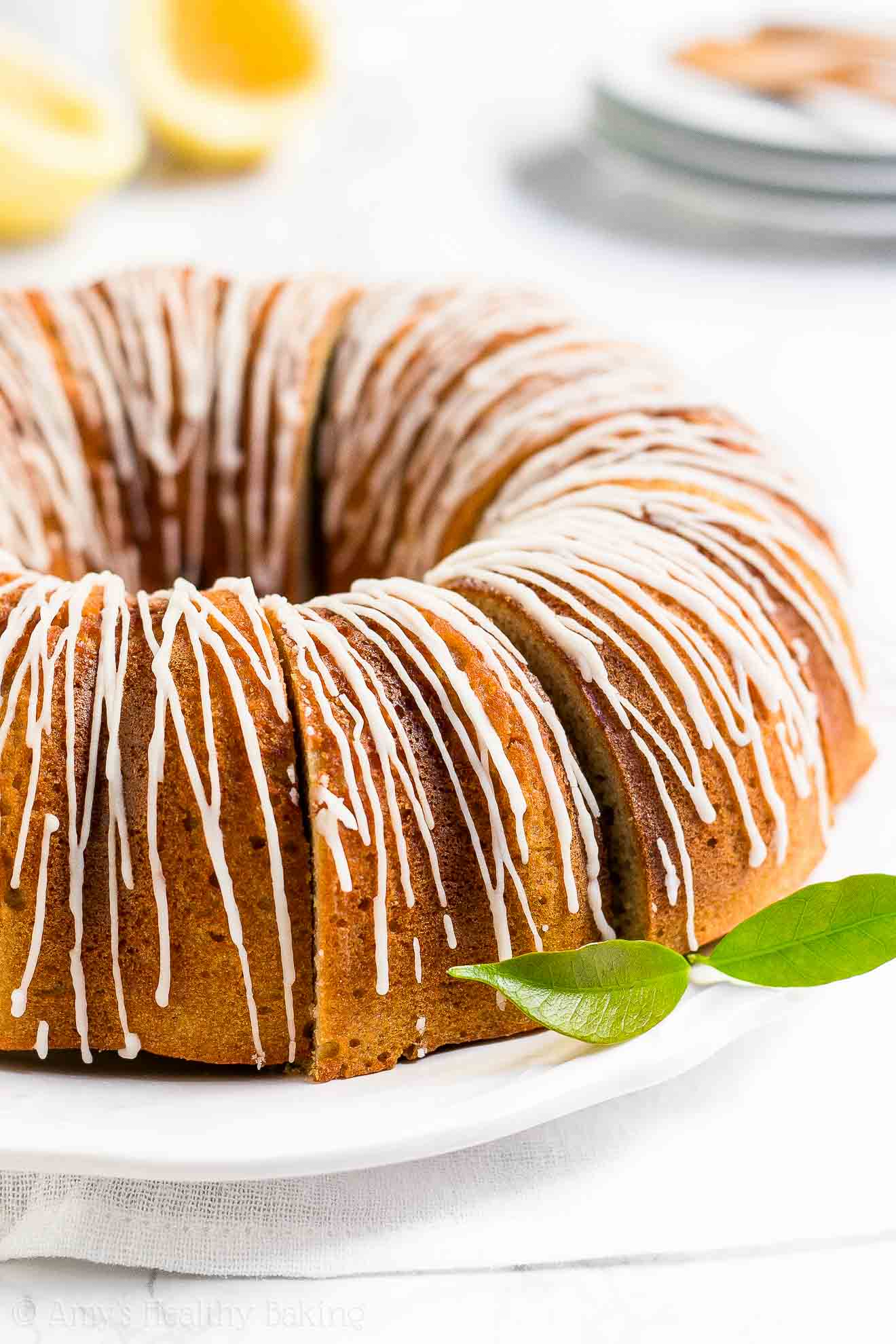
HOW TO MAKE THE BEST HEALTHY LEMON BUNDT CAKE
Time to pull out your mixing bowls and start making the batter! Here are my tips about how to make the best lemon bundt cake…
Measure correctly. Yes, I probably sound like a broken record — but it’s incredibly important to measure the ingredients correctly! This is especially true for the flour, lemon zest, and lemon juice in this particular recipe.
For the flour, use this method or a kitchen scale. (← That’s the one I own!) Do not dip your measuring cups directly into the flour container. This often results in adding up to 1 ½ times as much flour… Which dries out the batter, makes it more like a shaggy cookie dough, and can result in a crumbly cake. Take the time to measure properly, and you’ll end up with a beautifully moist and tender cake!
For the lemon zest and juice, measure by tablespoons or grams for the zest and tablespoons or mL for the juice. Do not measure by number of lemons! That will throw off the flavor of your cake, resulting in something that’s either bland (aka not enough zest) or sour (too much!). It can also ruin the texture by either adding too much acid from the lemon juice… Or not enough. (See the “Lemon juice” header in the “Key Ingredients to Make a Healthy Lemon Bundt Cake” section above for a detailed explanation of this last bit!)
Alternating additions. This is a popular technique for making cake batter. In a nutshell (or would that be a lemon wedge?), you’ll alternate between folding in part of the flour mixture, then switching to a splash of milk, and going back and forth between the two until you run out of each. This approach helps guard against overmixing (which makes a cake tough, gummy, or rubbery!). Just remember to gently stir in each one by hand, and you’ll end up with a perfectly moist and tender cake.
Prepare the bundt pan. Before you spread your healthy lemon cake batter into your bundt pan, generously coat your bundt cake pan with cooking spray. If you have cooking spray with flour, that’s even better! Bundt cake pans have lots more nooks and crannies than traditional round cake pans, so it’s much easier for the batter to get stuck… Which means your cake won’t want to slide out of the pan when you invert it. As long as you’re generous with the cooking spray, your healthy lemon bundt cake should pop right out of the pan.

Bake. Pop your batter-filled bundt pan in the oven, and set a timer! The cake will be done when the top feels firm to the touch and a toothpick inserted into the middle comes out clean or with some crumbs attached.
Cool completely. Yes, completely. Not mostly, not partially, and definitely not just a bit. Your cake must fully reach room temperature before you do anything else with it! The inside structure doesn’t finish setting until the cake is completely cool, so you’ll disrupt that process if you try to slice and serve it while it’s still warm. Also…
Glaze (optional). One last thing! Once your healthy lemon cake has fully cooled, you can drizzle a little glaze on top. Following the theme from above, it must completely reach room temperature before you do this. If your cake is warm, it’ll melt the glaze… So the glaze would dissolve right into the cake!
This optional glaze is super simple to make! Just stir together confectioners’ style erythritol and a bit of lemon juice in a small bowl, transfer that to a zip-topped bag, and snip off a tiny piece of one corner to drizzle it all over your bundt cake.
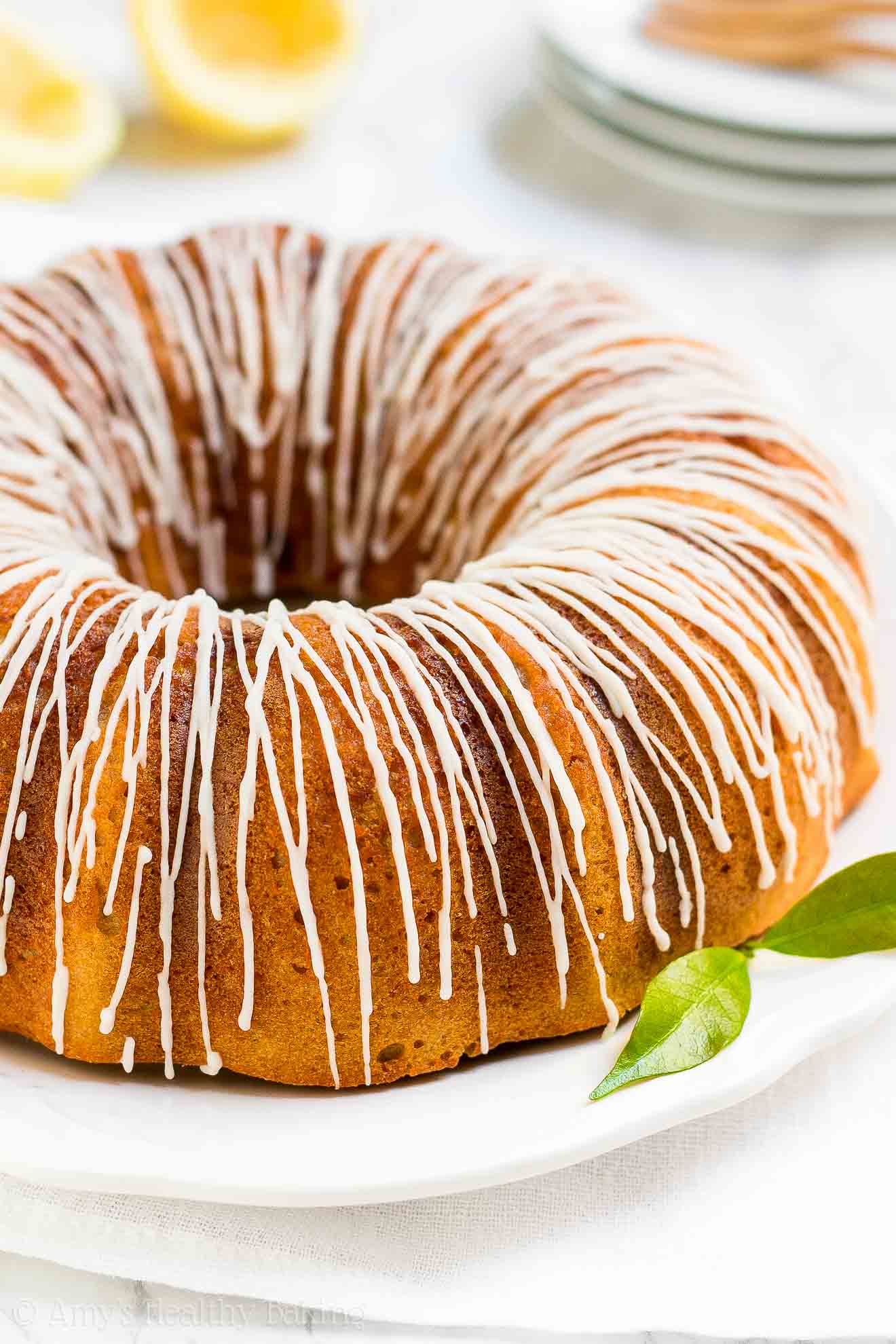
FAQS ABOUT THIS HEALTHY LEMON BUNDT CAKE
Is this healthy lemon bundt cake sugar-free, low calorie, low fat, clean eating, or gluten-free?
Yes — to everything! When baked according to the recipe, this healthy lemon bundt cake is clean eating, low fat, and low calorie (compared to many traditional recipes!) with no added sugar. I also included how to make it gluten-free and nut-free in the Notes section of the recipe.
Can I use a different flour?
Sure! Whole wheat pastry flour and all-purpose flour both perform beautifully. Regular whole wheat flour also works, but your cake may turn out slightly denser with a subtle wheat-y flavor in the background.
What about another type of milk?
Absolutely! Almost any kind will work, so feel free to use whatever currently sits in your fridge.
Can I use whole eggs?
You bet! Just decrease the milk by 2 tablespoons to compensate for the added volume from the yolks.
Can I substitute a different sweetener for the stevia?
Yup! I realize stevia doesn’t work for everyone, so I included some alternatives in the Notes section of the recipe.
What about for the erythritol?
Regular confectioners’ sugar is the best alternative. It’s much more absorbent though, so start with just 1 teaspoon of liquid in the drizzle and add more, a tiny bit at a time, until the glaze reaches your desired consistency.

I only have regular lemons, not Meyer lemons. Can I use them?
Yes — but you’ll need to reduce the amount of lemon juice. Regular lemons are much more acidic, which affects the texture of your cake, so you’ll use a combination of regular lemon juice and milk to replace the Meyer lemon juice. (See the Notes section of the recipe box for the exact amounts and the “Lemon juice” header in the “Key Ingredients to Make a Healthy Lemon Bundt Cake” section above for more nerdy information!)
My cake turned out really dense inside. It’s moist, but it’s really squat and barely rose. Why is that?
Did you use regular lemons? And the full amount of lemon juice? That’s why! This recipe was specifically designed for Meyer lemons. Like I just mentioned, regular lemons are substantially more acidic. When you substitute them for Meyer lemons — without adjusting the amount of lemon juice to compensate — it drastically lowers the pH of the batter. This results in a cake that’s incredibly dense and squat with very little to no rise. The cake may also appear raw inside (even though it’s not and is fully baked all the way through!). If you only have regular lemons, then see the Notes section of the recipe for how to adjust the ingredient amounts (and the “Lemon juice” header in the “Key Ingredients to Make a Healthy Lemon Bundt Cake” section above for more nerdy details!).
Mine tasted kind of bland. Do you know why?
There are two common culprits! First, if your cake tasted sweet but not very citrusy, then there probably wasn’t enough lemon zest in the batter. Make sure you use the full amount! The zest’s flavor is much more concentrated compared to the juice, so it provides the majority of the lemon taste.
Second, if your cake tasted bright and lemony but not sweet enough, did you substitute a different brand or type of sweetener? Then that was most likely the culprit! Many stevia brands and products have different sweetness levels, so they’re not necessarily 1-for-1 substitutes for each other. If you used a different brand or product, you may need to adjust the amount to compensate.
Something else to keep in mind… Stevia is often very concentrated, so a little goes a long way. In this recipe, the one I use is the equivalent of 2 ¼ cups of granulated sugar. If you opted for something else (like honey, pure maple syrup, or granulated sugar) as a 1-for-1 substitute, your cake was “missing” nearly 2 cups + 2 tablespoons of sweetener, which is why it didn’t taste sweet enough. See the Notes section of the recipe for the best sweetener alternatives and amounts to use!
How should I store this healthy lemon bundt cake? And how long will it last?
Store any leftover cake in an airtight container in the refrigerator. It should keep for at least three days, if not longer. (The drizzle’s appearance may change during that time frame, but that won’t affect the flavor!)

Bundt cake perfection. It’s truly the best lemon cake I’ve ever had! ♡ And when you make your own, remember to snap a picture and share it on Instagram using #amyshealthybaking and tagging @amyshealthybaking IN the photo itself. (That guarantees I’ll see your picture! 🙂 ) I’d love to see your healthy lemon bundt cake!

Healthy Lemon Bundt Cake
Ingredients
FOR THE CAKE
- 3 ¾ cups (450g) white whole wheat flour or gluten-free* flour (measured like this)
- 2 ¼ tsp baking powder
- 1 ½ tsp baking soda
- ½ tsp salt
- 4 tbsp (20g) lemon zest (about 3 extra-large — see Notes!)
- 1 tbsp (14g) unsalted butter or coconut oil, melted and cooled slightly
- 4 large egg whites, room temperature
- 4 tsp vanilla extract
- 5 ½ tsp liquid stevia (see Notes!)
- ¾ cup (180g) plain nonfat Greek yogurt
- ¾ cup (180mL) freshly squeezed Meyer lemon juice (about 3 extra-large — see Notes before beginning!)
- 1 ¼ cups (300mL) nonfat milk, divided
FOR THE DRIZZLE (OPTIONAL)
- 3 tbsp (45g) confectioners’ style erythritol
- 2 ½ - 2 ¾ tsp freshly squeezed lemon juice
Instructions
- Preheat the oven to 350°F, and generously coat a 12-cup bundt pan with nonstick cooking spray or nonstick cooking spray with flour.
- To prepare the cake, whisk together the flour, baking powder, baking soda, and salt in a medium bowl. Once thoroughly combined, whisk in the lemon zest. In a separate bowl, whisk together the butter or coconut oil, egg whites, vanilla extract, and stevia. Stir in the Greek yogurt, mixing until no large lumps remain. Stir in the lemon juice and ¼ cup of milk. Alternate between adding the flour mixture and remaining milk, beginning and ending with the flour mixture, and stirring just until incorporated. (For best results, add the flour mixture in 3 equal parts.)
- Spread the batter into the prepared pan. Bake at 350°F for 55-65 minutes or until the top feels firm to the touch and a toothpick inserted into the center comes out clean or with some crumbs attached. Cool in the pan for 10 minutes before transferring the cake to a wire rack to cool completely.
- Once the cake has completely cooled to room temperature and just before serving, prepare the drizzle. Stir together the erythritol and lemon juice in a small bowl. Transfer the mixture to a zip-topped plastic bag, cut off a tiny piece of one corner, and drizzle over the cooled cake.
Notes
View Nutrition Information + Weight Watchers Points
You may also like Amy’s other recipes…
♡ Healthy Orange Bundt Cake
♡ Healthy Blueberry Lemon Pound Cake
♡ Healthy Lemon Poppy Seed Pound Cake
♡ Healthy Strawberry Lemon Cake
♡ Healthy Raspberry Lemon Cake
♡ Healthy Lemon Cupcakes with Lemon Frosting
♡ …and the rest of Amy’s healthy bundt cake recipes and healthy cake recipes!


Disney themes and lemon treats = divine.
I love the way you think, Liz! 🙂
How do you recommend adapting this recipe if baking at high altitude???
I really appreciate your interest in my recipe, Marilyn! Other readers have reported that they don’t need to do anything to my recipes when baking at high altitude. (In fact, when they tried the common “high altitude” suggestions, the recipes turned out much worse!) I’d love to hear what you think if you try this cake! 🙂
So excited to see a Lemon Bundt Cake recipe without refined flour or sugars! I’m absolutely in love with the beautiful pictures you took of it, and I’ll definitely be adding this recipe to my collection! Did you use any photo editing apps to make the cake look that good? I appreciate that you added the Weight Watcher’s points with the nutrition facts!
Thanks so much for your kind words, Denise! I can’t wait to hear what you think of this cake! 🙂 (And I use Lightroom for photo editing!)
Is that 122 cal per slice or for the whole cake?
I really appreciate your interest in my recipe, Mads! The full nutrition information (which includes the answer to your question!) is directly beneath the recipe. It can be easy to miss! 😉 I can’t wait to hear what you think of this bundt cake if you try it!
I have Spenda Baturals stevia, not vanilla flavored. Rather than buy new, can I use and add vanilla?
I really think recipe looks good and would like to try.
I really appreciate your interest in my recipe, Amy! What’s the exact Splenda Naturals stevia product that you have? The packets, the jar, or the granulated type? None of those are as concentrated as the vanilla stevia that I use, so you’ll have to add a lot more and make modifications to the other ingredients as well. Just something to keep in mind! 🙂 I’m happy to help you figure out what those modifications are — I just need to know the exact format of Splenda Naturals stevia that you have!
Thanks so much! I have the jar. The conversion chart says 1 tsp sugar = 1/2 tsp. splenda naturals. 1 cup sugar = 1/2 cup splenda. I haven’t baked much with artificial sweeteners.
Thanks for the information, Amy! Super helpful. 🙂 You’d need to use 1 cup + 2 tablespoons of your Splenda Naturals stevia jar product. Then reduce the milk to ¾ cup to compensate for the added volume. You shouldn’t need to add any extra vanilla — the vanilla flavor isn’t very strong in the liquid vanilla stevia that I use. I can’t wait to hear what you think of this bundt cake!
Oh awesome! I CANNOT wait for your new recipe!
LOve
Hello
I really want to try your recipe but I only have Splenda Granulated Sugar. The chart says 1 c of splenda of every 1 c of granulated sugar. Do you mind tell me the modification I have to make to achieve the same tesult ?
Thanks!
I really appreciate your interest in my recipe Candy! I’ve actually included the modification to substitute regular granulated sugar in the Notes section of the recipe, so use that for your Splenda Granulated Sugar. (I know it can be easy to miss that section!) 🙂 I can’t wait to hear what you think of this bundt cake!
Thank you for your reply. Will it change the texture and height of the cake by subtituting it with Solenda? Thanks again!
It’s my pleasure, Candy! I haven’t personally tried that substitution, so I can’t vouch for that. However, I have a feeling the cake should still rise properly and the texture should most likely be about the same! 🙂 I can’t wait to hear how your lemon bundt cake turns out!
Hi Amy,
I tried making it using the sugar substitute product you suggested. It tasted bitter compared with Splenda. Is it right? Also, the cake turned out not moist and had brown spots here and there. I followed your steps as exactly so I am not sure what happened. I also think the lemon taste was weak, I ended up adding 1 teaspoon of lemon extract.
Any suggestions to improve the overall cake taste and texture?
Let’s get all of that sorted out Candy! Just to make sure I understand what’s going on, you’ve made two cakes, correct? The first one with Splenda instead of the granulated sugar substitute in the Notes section, and the second with the same liquid vanilla stevia that I use? Did both cakes turn out dry, with brown spots, and weak lemon flavor? Or just the second? And finally, what type of lemons did you use? With that info, I should be able to figure out what happened! 🙂
Hi Amy,
I only made it 1 time using your recommended liquid sweetener and regular lemons since I couldn’t find Meyer lemons. Thanks for helping!
Thanks for the info Candy! If the cake tasted bitter to you and my recommend liquid stevia wasn’t sweet enough, compared to when you use Splenda’s cup-for-cup granulated product in baking recipes, then you can add 4 tablespoons of that to the batter to make it sweeter! That will probably add an extra 5-10 minutes to the baking time, but the flavor should be sweeter and closer to your liking. 🙂
Regular lemons will affect the texture; they’ll give it a slightly more dense texture and a bit of a raw appearance (don’t worry — the cake will be fully cooked through! — it’s just the appearance). Did you use the full amount of lemon zest, and did you measure it by tablespoons or “3 extra-large lemons”? Did the brown spots have a distinct flavor? If the cake wasn’t moist, was it dry? Did you use measuring cups to measure the flour, and if so, how did you do that? I’m happy to sort through all of those issues too!
Great recipe! Worked perfectly like always.
Do you have any suggestions for making the cake fluffier and lighter tho?
I’m so glad you enjoyed this bundt cake Sai! This particular recipe was designed to be really moist and slightly denser, not light and fluffy like the texture of angel food cake. As soon as I develop a recipe for light and fluffy cake, I’ll post it here on my blog! 🙂
Hi Amy,
Sorry for my late reply. Somehow I didn’t see it. I measured using cups for dry ingredients and tablespoon for lemon zest ( I packed them!). The cake texture was more on the drier side. I am ready to make another one but I wanted to make sure Ihave all the inputs from you first. How do get 4 tbs of lemon zests? I bought a bag of Meyer Lemons from Trader Joe and they only gave me 1 1/2 tbs of zest! Thanks a lot!
No need to apologize Candy! If your cake texture was on the dry side, then there was probably too much flour in it. It’s actually really easy to accidentally add too much flour when using measuring cups, but here’s my trick to avoid that!
If you don’t own a kitchen scale, here’s what I recommend doing for measuring flour (and cocoa powder, oats, etc!): use a fork to “scoop” up flour from the container, and lightly shake the fork back and forth over the top of your measuring cup to transfer the flour into it. Once there’s a small mound of flour extending past the rim of the measuring cup, then place the flat back of a knife against the top of the measuring cup, and gently scrape it across the top to get rid of the excess flour. Never “pat” the flour down with the knife or fork. This fork method acts like a sifter (without dirtying another dish!) and guarantees you’ll add less flour to the batter, so you’ll end up with a moist and tender cake. Does that make sense? 🙂
If you only added 1 ½ tablespoons of lemon zest, then that’s definitely why the lemon taste was so weak! The zest actually provides the majority of the lemon flavor, as I covered in the Notes section of the recipe. Are you using a true zester to zest your lemons, or are you using a grater with small holes? I’ve found that the small graters don’t yield nearly as much zest as actual zesters, partially because their holes are differently shaped and often not quite as sharp as a zester’s! This is the zester that I own. Super affordable and 100% worth every penny!
Hi Amy,
I’ve been looking forward to baking your Lemon Bundt cake. It did not turn out as I hoped. First, I bought Swan’s Down cake flour thinking it would work well. I used Meyer lemons which are so smooth I skin and difficult to zest.
I followed the recipe exactly measuring precisely. The cake is under 2” high and not a nice texture. It’s quite tough.
Can you determine what could be the problem?
I really appreciate your interest in my recipe Janet! That sounds disappointing, so I’d love to help figure out what went wrong. Did you use an electric or stand mixer to mix together the batter? How did you measure the flour — with a kitchen scale or measuring cups? If the latter, can you describe in detail how you measured? Did you make any other modifications to the recipe, including those listed in the Notes section, other than the cake flour? Did you add the full amount of lemon juice and lemon zest? And finally, how fresh are your baking powder and baking soda? Once I know all of that information, I should have a better idea of what caused the issues that you experienced! 🙂
Amy,
Thanks for your rapid response. I did not use an electric mixer since the recipe indicates to stir alternatating the flour and milk. I guess that would be a major factor as to the heaviness of the cake.
Baking powder and soda are new. I measured flour by filling the cups with spoonfuls then running a knife across the top. Lemon juice was exact. The zest was close to 3 tbsp.
It’s my pleasure Janet! How was the flavor? Did you make any other modifications, including those listed in the Notes section?
What did you use to stir in the milk and flour mixture? Usually a tough cake texture is a result of overmixing, so I generally recommend using a whisk where instructed and a fork for everything else (like with stirring in the milk and flour mixture!) because the tines of the fork allow for the ingredients to be incorporated better compared to a spoon or spatula.
If you don’t own a kitchen scale, here’s what I recommend doing for measuring flour (and cocoa powder, oats, etc!): use a fork to “scoop” up flour from the container, and lightly shake the fork back and forth over the top of your measuring cup to transfer the flour into it. Once there’s a small mound of flour extending past the rim of the measuring cup, then place the flat back of a knife against the top of the measuring cup, and gently scrape it across the top to get rid of the excess flour. Never “pat” the flour down with the knife or fork. This fork method acts like a sifter (without dirtying another dish!) and guarantees you’ll add less flour to the batter, so you’ll end up with moist and tender cake. Does that make sense? 🙂